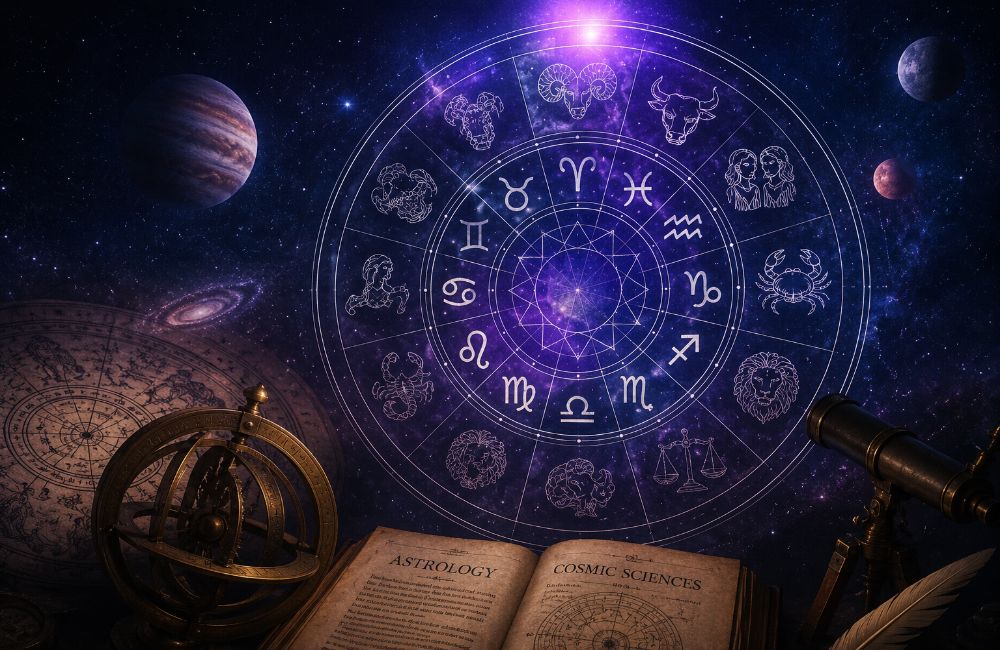
Since the earliest days of human civilization, people have looked up at the night sky with curiosity and wonder. The Sun, Moon, stars, and planets inspired countless questions about the universe and humanity’s place within it. Ancient cultures observed the regular movements of celestial bodies and used these observations to measure time, predict seasons, guide agricultural activities, and perform religious ceremonies. Over centuries, these observations gave rise to two distinct fields of knowledge: the scientific study of the universe, known today as astronomy and cosmology, and astrology, a traditional system that interprets the symbolic significance of celestial movements in relation to human life.
In India, astrology is known as Jyotish, meaning “the science of light.” It is one of the oldest traditional knowledge systems and has been preserved through generations in Sanskrit texts and oral traditions. Jyotish has historically been used to prepare calendars, determine the timing of festivals, and select auspicious moments for important events. Many people also consult it for personal guidance regarding education, career, marriage, finances, and spiritual growth. While these interpretations remain an important part of cultural and religious traditions, they are based on longstanding beliefs rather than scientific evidence.
Cosmic sciences, on the other hand, explore the universe through observation, mathematics, experimentation, and technology. They seek to understand the origin of stars, planets, galaxies, black holes, and the universe itself. Together, astrology and cosmic sciences reflect two different ways in which humanity has sought to understand the cosmos-one through symbolism and tradition, and the other through scientific inquiry.
Jyotish: The Traditional Indian System of Astrology
The Sanskrit word Jyotish is derived from Jyoti, meaning “light.” Traditionally, it refers to the study of celestial bodies and their symbolic relationship with time and human activities. Jyotish is one of the six Vedangas, the auxiliary disciplines associated with the Vedas, and has historically been important for determining calendars, religious observances, and ceremonial timings.
Traditional Jyotish is based on the idea that the positions of the Sun, Moon, planets, and stars at the time of a person’s birth form a symbolic map known as a birth chart or Kundli. Practitioners interpret this chart to understand personality traits, strengths, challenges, opportunities, and life cycles.
The major branches of Jyotish include:
- Natal Astrology (Janma Kundli)
- Predictive Astrology
- Muhurta (selection of auspicious times)
- Prashna (Horary Astrology)
- Mundane Astrology
- Medical Astrology
- Spiritual Astrology
Although interpretations differ among traditions and practitioners, Jyotish continues to play an important role in many families and communities.
Birth Charts (Kundli)
A birth chart, commonly called a Kundli, is the foundation of Jyotish. It is prepared using three essential pieces of information:
- Date of birth
- Exact time of birth
- Place of birth
Using these details, the positions of the Sun, Moon, planets, zodiac signs, and the Ascendant (Lagna) are mapped for the moment of birth.
In traditional practice, the birth chart serves as a symbolic representation of an individual’s life. Astrologers analyze the relationships between planets, signs, and houses to interpret areas such as personality, education, career, health, relationships, finances, and spiritual inclinations. The chart is also used to study planetary periods (Dashas) and transits, which are believed by practitioners to indicate changing life circumstances over time.
The Twelve Houses (Bhavas)
The birth chart is divided into twelve houses, each representing a different aspect of life. Rather than describing a person’s character alone, the houses provide a framework for interpreting experiences across different areas of life.
The First House represents personality, physical appearance, health, and self-identity. It is considered the starting point of the chart because it reflects how a person approaches life.
The Second House is associated with wealth, family, speech, and accumulated resources.
The Third House represents communication, courage, younger siblings, skills, and determination.
The Fourth House relates to home, mother, education, property, comfort, and emotional security.
The Fifth House is linked with creativity, intelligence, learning, children, and artistic expression.
The Sixth House concerns health, daily work, service, debts, competition, and overcoming challenges.
The Seventh House governs marriage, partnerships, business relationships, and public interactions.
The Eighth House symbolizes transformation, longevity, inheritance, research, mysteries, and significant life changes.
The Ninth House represents higher education, philosophy, religion, ethics, fortune, and long-distance travel.
The Tenth House is connected with career, profession, achievements, leadership, and social reputation.
The Eleventh House represents gains, friendships, ambitions, networks, and fulfillment of goals.
The Twelfth House is associated with spirituality, meditation, charity, foreign travel, isolation, and liberation.
Together, these twelve houses provide the structure through which traditional astrologers interpret the symbolism of a birth chart.
Planets (Navagrahas)
In Jyotish, nine principal planetary influences, collectively called the Navagrahas, are considered central to chart interpretation.
The Sun (Surya) traditionally symbolizes authority, vitality, confidence, leadership, and personal identity.
The Moon (Chandra) represents the mind, emotions, imagination, sensitivity, and the nurturing aspect of life.
Mars (Mangala) signifies courage, energy, strength, determination, and action.
Mercury (Budha) is associated with communication, learning, analytical thinking, business, and adaptability.
Jupiter (Guru) symbolizes wisdom, knowledge, prosperity, ethics, teaching, and spirituality.
Venus (Shukra) represents beauty, love, relationships, comfort, luxury, creativity, and artistic talents.
Saturn (Shani) is linked with discipline, responsibility, patience, perseverance, and long-term effort.
Rahu and Ketu are not physical planets but the lunar nodes. In traditional astrology, Rahu is associated with ambition, innovation, and worldly pursuits, while Ketu is associated with detachment, introspection, and spiritual development.
The interpretation of these planetary influences depends on their placement within the birth chart, their relationships with one another, and their positions in the zodiac signs and houses.
Astrological Remedies
One distinctive feature of Jyotish is the concept of remedies. Traditional practitioners believe that certain spiritual and charitable practices may help strengthen beneficial influences or symbolically address challenging planetary placements.
Commonly recommended remedies include chanting sacred mantras, meditation, charitable donations, fasting, temple worship, acts of service, and the recitation of religious scriptures. Some traditions also recommend gemstones, though these are generally chosen only after a detailed chart analysis.
These remedies are rooted in religious and cultural traditions. Their significance is primarily spiritual and symbolic, and their effectiveness is a matter of personal belief rather than scientific validation.
Muhurta: Choosing the Right Time
Muhurta is the traditional practice of selecting an auspicious time to begin an important activity. The belief underlying Muhurta is that favorable timing may contribute to the successful completion of an undertaking.
Important occasions for which Muhurta is commonly selected include weddings, housewarming ceremonies, starting a business, purchasing property or vehicles, naming ceremonies, religious rituals, and major journeys.
The selection of a Muhurta traditionally considers several factors, including the lunar day, weekday, Nakshatra, planetary positions, and other calendar elements.
Auspicious Timings
Indian tradition places great emphasis on performing important activities at appropriate times. Auspicious timings are determined by consulting the Panchang and considering combinations of Tithi (lunar day), Vara (weekday), Nakshatra (lunar mansion), Yoga, and Karana.
Different traditions may recommend favorable periods for ceremonies, religious observances, and new beginnings while advising against others for specific purposes. These practices continue to be widely followed during festivals and family celebrations.
Numerology
Numerology is another traditional system that studies the symbolic significance of numbers. Practitioners believe that numbers derived from a person’s birth date or name may offer insights into personality, life themes, and compatibility.
Common concepts include the Birth Number, Destiny Number, Name Number, and Personal Year Number. While numerology is popular in many cultures, its interpretations are based on symbolic traditions rather than scientific evidence.
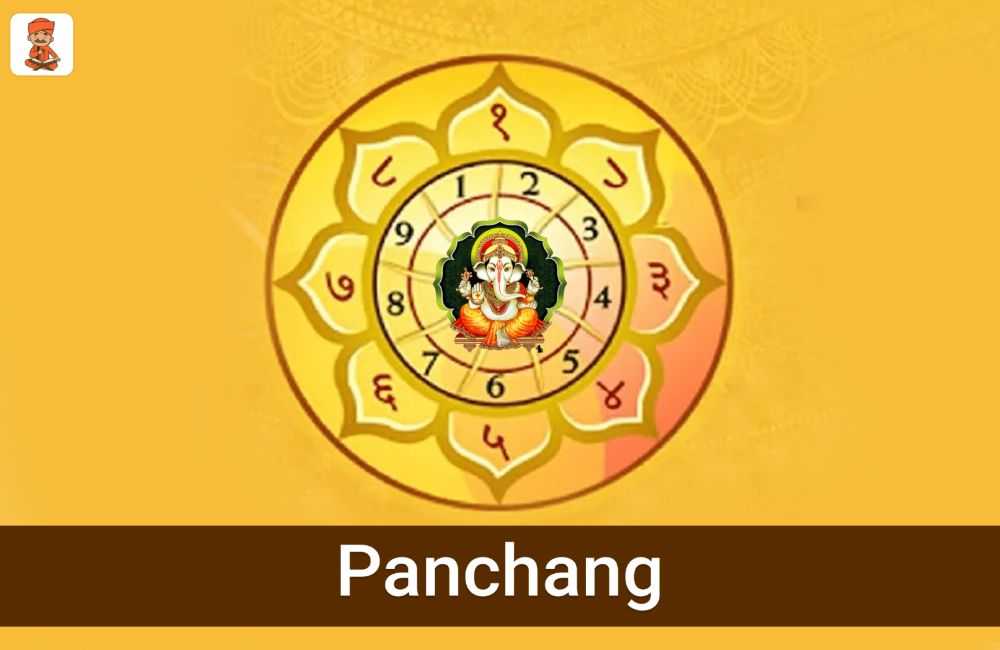
Panchang
The Panchang is the traditional Hindu almanac used to determine religious festivals, rituals, and ceremonial timings. It consists of five principal elements:
- Tithi (Lunar Day)
- Vara (Weekday)
- Nakshatra (Lunar Mansion)
- Yoga
- Karana
Together, these five components provide the basis for selecting Muhurtas and organizing the traditional Hindu calendar.
Nakshatra Knowledge
The zodiac is traditionally divided into twenty-seven Nakshatras, or lunar mansions, through which the Moon appears to travel during its monthly cycle.
Each Nakshatra has its own name, ruling deity, planetary ruler, symbolic meaning, and associated characteristics. Traditional astrologers use the Moon’s Nakshatra to interpret temperament, compatibility, ceremonial timings, and certain life themes.
Nakshatras also play an important role in naming ceremonies, marriage matching, and the selection of auspicious dates for religious observances.
Astrology and Modern Cosmic Sciences
Although astrology and cosmic sciences share a historical connection through early observations of the sky, they have developed into distinct disciplines.
Modern astronomy, astrophysics, and cosmology rely on observation, mathematics, experimentation, and evidence to understand celestial objects and the evolution of the universe. These scientific fields have led to discoveries such as galaxies beyond the Milky Way, exoplanets orbiting distant stars, black holes, gravitational waves, and the expanding universe.
Astrology, by contrast, is a traditional interpretive system that assigns symbolic meaning to celestial positions in relation to human life. Its methods and predictive claims have not been validated by scientific testing. Nevertheless, astrology continues to be valued by many people for cultural, historical, philosophical, and spiritual reasons.
Understanding the distinction between these two approaches allows us to appreciate both humanity’s scientific achievements and its rich cultural traditions.
Astrology and Cosmic Sciences reflect humanity’s enduring fascination with the universe. Jyotish has remained an integral part of Indian culture for centuries, providing a traditional framework for interpreting birth charts, planetary symbolism, houses, Nakshatras, Panchang, Muhurta, remedies, and numerology. At the same time, modern cosmic sciences have transformed our understanding of the universe through observation and evidence-based research.
Whether approached as a cultural tradition, a subject of historical study, or a scientific discipline, the exploration of the cosmos continues to inspire curiosity, reflection, and a deeper appreciation of the world around us. By understanding both traditional knowledge systems and modern science, we gain a broader perspective on humanity’s timeless quest to understand the heavens.