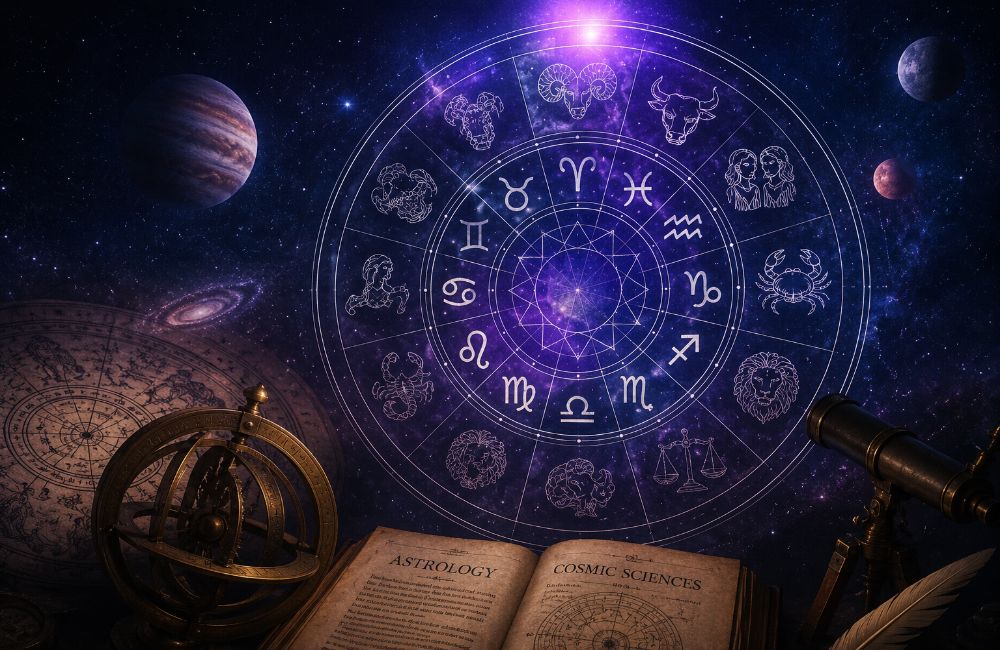

Natal Astrology, known in India as Janma Kundli or Birth Chart Astrology, is a branch of astrology that studies the positions of celestial bodies at the exact moment of a person’s birth. According to the tradition, the date, time, and place of birth create a unique astrological chart that is interpreted to understand different aspects of an individual’s life, personality, strengths, challenges, relationships, career, and potential life events.
A Janma Kundli is typically divided into twelve houses, each representing a specific area of life such as personality, wealth, family, education, health, marriage, career, and spirituality. The placement of the nine planets (Navagrahas), the twelve zodiac signs (Rashis), and the twenty-seven lunar constellations (Nakshatras) within these houses forms the basis of astrological analysis. Astrologers also examine planetary aspects, conjunctions, yogas, and planetary periods (Dashas) to provide deeper insights.
One of the most important elements of a Janma Kundli is the Ascendant (Lagna), which represents the zodiac sign rising on the eastern horizon at the time of birth. The Lagna influences a person’s physical appearance, temperament, and overall approach to life. The Moon sign (Rashi) reflects emotions, mental disposition, and inner nature, while the Sun sign symbolizes vitality, confidence, and individuality.
Janma Kundli is commonly consulted for various life decisions, including career planning, marriage compatibility (Kundli matching), education, financial planning, health awareness, and selecting auspicious dates for important events (Muhurta). It is also used to identify favorable and challenging planetary influences and, in some traditions, recommend spiritual practices or remedies.
While many people value Janma Kundli as a cultural, spiritual, or traditional practice, its claims have not been scientifically validated. As a result, astrology is generally regarded as a belief system rather than an evidence-based science. For many individuals, however, it continues to serve as a framework for self-reflection, personal guidance, and preserving cultural traditions.
In summary, Natal Astrology or Janma Kundli is a detailed birth chart based on the precise time and location of birth. It seeks to provide insights into a person’s life journey by interpreting the symbolic relationships between planets, zodiac signs, and astrological houses, while its interpretations remain matters of personal belief rather than established scientific fact.
How to read a Janma Kundli (Birth Chart) involves understanding the positions of the planets, zodiac signs, and houses at the time of birth. While professional astrologers study these concepts in depth, beginners can learn the basics by following a structured approach.
Step 1: Know the Birth Details
A Janma Kundli is prepared using:
- Date of birth
- Exact time of birth
- Place of birth
Even a small difference in birth time can change the Ascendant (Lagna) and the house placements.
Step 2: Identify the Ascendant (Lagna)
The Lagna is the zodiac sign rising on the eastern horizon at the moment of birth. It forms the first house of the chart and serves as the foundation for interpreting the entire Kundli.
The Ascendant helps determine:
- Personality and appearance
- Physical health
- Overall life path
- House placements of all other signs
Step 3: Understand the Twelve Houses
Each house represents a different area of life.
| House | Represents |
| 1st | Self, personality, health |
| 2nd | Wealth, speech, family |
| 3rd | Courage, communication, siblings |
| 4th | Home, mother, property, happiness |
| 5th | Education, children, creativity |
| 6th | Health, debts, enemies, service |
| 7th | Marriage, partnerships |
| 8th | Transformation, inheritance, longevity |
| 9th | Fortune, religion, higher education |
| 10th | Career, profession, reputation |
| 11th | Income, gains, friendships |
| 12th | Expenses, spirituality, foreign travel |
Step 4: Study the Zodiac Signs
The twelve zodiac signs influence how each house expresses itself.
- Aries
- Taurus
- Gemini
- Cancer
- Leo
- Virgo
- Libra
- Scorpio
- Sagittarius
- Capricorn
- Aquarius
- Pisces
Each sign has unique qualities that affect the house in which it appears.
Step 5: Learn the Nine Planets (Navagrahas)
| Planet | Signifies |
| Sun | Authority, confidence, father |
| Moon | Mind, emotions, mother |
| Mars | Energy, courage, action |
| Mercury | Intelligence, communication |
| Jupiter | Wisdom, knowledge, prosperity |
| Venus | Love, beauty, relationships |
| Saturn | Discipline, responsibility, karma |
| Rahu | Ambition, innovation, worldly desires |
| Ketu | Spirituality, detachment, past karma |
- Which house each planet occupies.
- Which zodiac sign each planet is in.
- Whether the planet is considered strong, weak, or in a favorable or unfavorable placement according to the astrological system being used.
Step 6: Find the Moon Sign (Rashi)
The Moon’s position determines the Rashi, which reflects emotional nature and mental tendencies. Many predictive techniques in Indian astrology use the Moon sign as a key reference.
Step 7: Check Planetary Relationships
Astrologers often analyze:
- Conjunctions (planets in the same house)
- Aspects (planetary influences on other houses)
- Yogas (special planetary combinations)
- Strengths and weaknesses of planets
These combinations are interpreted together rather than in isolation.
Step 8: Study the Dashas
The Vimshottari Dasha system is commonly used in Vedic astrology to indicate which planet’s influence is believed to be most active during different periods of life. Interpreters combine Dasha analysis with current planetary transits to assess timing of events.
Step 9: Analyze House Lords
Each zodiac sign has a ruling planet. The placement of the ruler of each house is considered important because it is thought to influence the matters associated with that house.
For example:
- If Leo occupies the 10th house, the Sun is the ruler of the 10th house.
- The Sun’s placement elsewhere in the chart is then interpreted in relation to career and reputation.
Step 10: Combine the Information
Rather than focusing on a single planet or house, a complete reading considers:
- Ascendant (Lagna)
- House meanings
- Planetary placements
- Zodiac signs
- Planetary aspects
- Yogas
- Dashas
- Current transits
The overall interpretation is based on how these factors interact.
Example (Simplified)
Suppose a chart has:
- Aries Lagna
- Sun in the 10th house
- Jupiter in the 9th house
- Moon in the 4th house
A traditional interpretation might suggest:
- A confident and energetic personality (Aries Ascendant).
- Strong emphasis on career and leadership (Sun in the 10th).
- Interest in higher learning or spiritual pursuits (Jupiter in the 9th).
- Emotional connection to home and family (Moon in the 4th).
In practice, an astrologer would also consider aspects, planetary strengths, Dashas, and other chart factors before drawing conclusions.
Reading a Janma Kundli is a skill that takes time to develop. It involves understanding symbolic relationships within the chart, and interpretations vary among different schools of astrology. Astrology is widely practiced as a cultural and spiritual tradition, but its predictive claims are not scientifically established.
Rashi in detail
Rashi (Zodiac Signs) in Detail
In Vedic Astrology (Jyotish), a Rashi is a zodiac sign through which the Moon, Sun, and planets move. The zodiac is divided into 12 Rashis, with each covering 30 degrees of the 360-degree zodiac. A person’s Janma Rashi (Moon Sign) is the zodiac sign occupied by the Moon at the time of birth and is considered especially important in Vedic astrology.
Each Rashi has unique qualities, an element, a ruling planet, and characteristics that are traditionally believed to influence personality and life experiences.
1. Mesha (Aries)
- Symbol: Ram
- Element: Fire
- Ruling Planet: Mars
- Nature: Movable (Chara)
- Direction: East
Personality
People born under Mesha Rashi are traditionally described as energetic, courageous, ambitious, and confident. They enjoy taking initiative and often prefer leadership roles. They tend to be independent and action-oriented.
Strengths
- Brave and determined
- Natural leadership
- Competitive spirit
- Quick decision-maker
Challenges
- Can be impatient
- May act impulsively
- Sometimes short-tempered
Suitable Careers
- Military
- Police
- Engineering
- Sports
- Entrepreneurship
- Management
2. Vrishabha (Taurus)
- Symbol: Bull
- Element: Earth
- Ruling Planet: Venus
- Nature: Fixed (Sthira)
Personality
Vrishabha natives are traditionally associated with stability, patience, practicality, and a love of comfort. They value security and often work steadily toward long-term goals.
Strengths
- Reliable
- Loyal
- Hardworking
- Financially conscious
Challenges
- Can be stubborn
- Resistant to change
- Possessive at times
Suitable Careers
- Banking
- Agriculture
- Music
- Fashion
- Finance
- Real estate
3. Mithuna (Gemini)
- Symbol: Twins
- Element: Air
- Ruling Planet: Mercury
- Nature: Dual (Dwiswabhava)
Personality
Mithuna individuals are often described as curious, communicative, adaptable, and intellectually inclined. They enjoy learning and interacting with others.
Strengths
- Intelligent
- Versatile
- Good communicator
- Quick learner
Challenges
- Indecisive
- Easily distracted
- Restless
Suitable Careers
- Journalism
- Teaching
- Marketing
- Writing
- Sales
- Information Technology
4. Karka (Cancer)
- Symbol: Crab
- Element: Water
- Ruling Planet: Moon
- Nature: Movable
Personality
Karka natives are traditionally associated with emotional sensitivity, nurturing, and strong family values. They are believed to be intuitive and caring.
Strengths
- Compassionate
- Protective
- Loyal
- Imaginative
Challenges
- Moody
- Sensitive to criticism
- Can worry excessively
Suitable Careers
- Healthcare
- Education
- Hospitality
- Psychology
- Social work
5. Simha (Leo)
- Symbol: Lion
- Element: Fire
- Ruling Planet: Sun
- Nature: Fixed
Personality
Simha individuals are traditionally described as confident, generous, and charismatic. They often enjoy recognition and may thrive in positions of responsibility.
Strengths
- Leadership
- Confidence
- Creativity
- Generosity
Challenges
- Pride
- Stubbornness
- Desire for appreciation
Suitable Careers
- Politics
- Administration
- Acting
- Business
- Leadership positions
6. Kanya (Virgo)
- Symbol: Maiden
- Element: Earth
- Ruling Planet: Mercury
- Nature: Dual
Personality
Kanya natives are often associated with analytical thinking, organization, and attention to detail. They tend to value precision and practical solutions.
Strengths
- Practical
- Intelligent
- Organized
- Responsible
Challenges
- Overthinking
- Perfectionism
- Excessive self-criticism
Suitable Careers
- Medicine
- Accounting
- Research
- Data Analysis
- Editing
7. Tula (Libra)
- Symbol: Balance
- Element: Air
- Ruling Planet: Venus
- Nature: Movable
Personality
Tula individuals are traditionally linked with balance, diplomacy, fairness, and appreciation of beauty. They often seek harmony in relationships.
Strengths
- Diplomatic
- Cooperative
- Social
- Artistic
Challenges
- Difficulty making decisions
- Avoidance of conflict
- Dependence on others’ opinions
Suitable Careers
- Law
- Fashion
- Interior Design
- Public Relations
- Diplomacy
8. Vrishchika (Scorpio)
- Symbol: Scorpion
- Element: Water
- Ruling Planet: Mars
- Nature: Fixed
Personality
Vrishchika natives are traditionally described as determined, resourceful, and emotionally intense. They are often believed to possess strong intuition.
Strengths
- Courageous
- Focused
- Loyal
- Investigative
Challenges
- Secretive
- Jealous
- Can hold grudges
Suitable Careers
- Research
- Detective work
- Surgery
- Psychology
- Intelligence services
9. Dhanu (Sagittarius)
- Symbol: Archer
- Element: Fire
- Ruling Planet: Jupiter
- Nature: Dual
Personality
Dhanu individuals are often associated with optimism, curiosity, and a love of learning. They may enjoy travel, philosophy, and exploring new ideas.
Strengths
- Honest
- Optimistic
- Wise
- Adventurous
Challenges
- Impatient
- Blunt in communication
- Overconfident
Suitable Careers
- Teaching
- Law
- Religious studies
- Travel industry
- Publishing
10. Makara (Capricorn)
- Symbol: Sea-Goat (Crocodile in some Indian traditions)
- Element: Earth
- Ruling Planet: Saturn
- Nature: Movable
Personality
Makara natives are traditionally characterized as disciplined, ambitious, and practical. They are believed to value hard work and long-term achievement.
Strengths
- Responsible
- Patient
- Organized
- Determined
Challenges
- Serious nature
- Work-life imbalance
- Reserved emotions
Suitable Careers
- Government
- Engineering
- Construction
- Management
- Administration
11. Kumbha (Aquarius)
- Symbol: Water Bearer
- Element: Air
- Ruling Planet: Saturn
- Nature: Fixed
Personality
Kumbha individuals are traditionally associated with innovation, humanitarian ideals, and independent thinking. They often enjoy exploring unconventional ideas.
Strengths
- Creative
- Independent
- Friendly
- Visionary
Challenges
- Detached
- Unpredictable
- Stubborn
Suitable Careers
- Science
- Technology
- Social Work
- Research
- Innovation
12. Meena (Pisces)
- Symbol: Two Fish
- Element: Water
- Ruling Planet: Jupiter
- Nature: Dual
Personality
Meena natives are traditionally described as compassionate, imaginative, and spiritually inclined. They often have a strong sense of empathy.
Strengths
- Kind
- Creative
- Intuitive
- Adaptable
Challenges
- Overly emotional
- Idealistic
- Difficulty setting boundaries
Suitable Careers
- Arts
- Music
- Spiritual teaching
- Counseling
- Healthcare
Summary Table
| Rashi | English Name | Ruling Planet | Element | Nature |
| Mesha | Aries | Mars | Fire | Movable |
| Vrishabha | Taurus | Venus | Earth | Fixed |
| Mithuna | Gemini | Mercury | Air | Dual |
| Karka | Cancer | Moon | Water | Movable |
| Simha | Leo | Sun | Fire | Fixed |
| Kanya | Virgo | Mercury | Earth | Dual |
| Tula | Libra | Venus | Air | Movable |
| Vrishchika | Scorpio | Mars | Water | Fixed |
| Dhanu | Sagittarius | Jupiter | Fire | Dual |
| Makara | Capricorn | Saturn | Earth | Movable |
| Kumbha | Aquarius | Saturn | Air | Fixed |
| Meena | Pisces | Jupiter | Water | Dual |
These descriptions reflect traditional interpretations in Vedic astrology. In practice, astrologers generally do not interpret a person’s life based on their Rashi alone. A complete reading also considers the Lagna (Ascendant), the positions of the planets in the houses, Nakshatras, planetary aspects, yogas, and Dasha periods. Additionally, astrology is regarded as a cultural and spiritual tradition rather than a scientifically established method for predicting personality or future events.