
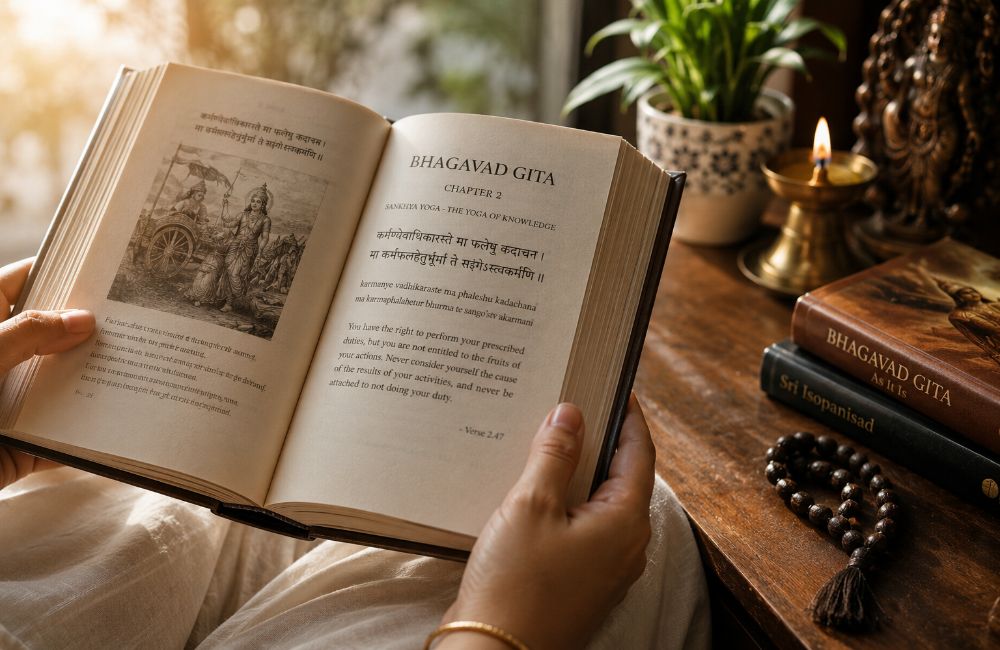
The Bhagavad Gita is one of the world’s most respected philosophical and spiritual texts. Written more than two thousand years ago as part of the Indian epic, the Mahabharata, it is much more than a religious scripture. At its heart, the Gita is a conversation about life-its challenges, responsibilities, emotions, choices, and purpose.
Although it was composed in ancient India, its teachings continue to inspire people across cultures, professions, and beliefs. Students, entrepreneurs, athletes, scientists, military leaders, psychologists, and philosophers have all found wisdom in its pages. The reason is simple: the questions it explores are timeless. How do we deal with fear? How do we make difficult decisions? What is the right thing to do when life becomes uncertain? How can we find peace without giving up ambition?
The Bhagavad Gita does not promise a life without problems. Instead, it teaches us how to face problems with clarity, courage, and wisdom.
The Story Behind the Bhagavad Gita
The Bhagavad Gita takes place on the battlefield of Kurukshetra. Just before a great war begins, the warrior prince Arjuna is overwhelmed with doubt. Standing before him are relatives, teachers, and friends who will be fighting on the opposing side. Confused, anxious, and emotionally exhausted, Arjuna questions whether the battle is worth fighting at all.
At this critical moment, his charioteer, Lord Krishna, becomes his guide. Rather than simply telling Arjuna what to do, Krishna helps him understand himself, his responsibilities, and the deeper nature of life.
This conversation, consisting of 700 verses, became the Bhagavad Gita. While the setting is a battlefield, the real battle is internal-the struggle between fear and courage, confusion and wisdom, attachment and purpose. That inner conflict is something every person experiences, regardless of time or place.
Why Is the Bhagavad Gita Still Relevant Today?
Today’s world is faster, more connected, and more competitive than ever before. Young people face academic pressure, career uncertainty, social media comparison, financial concerns, relationship challenges, and constant information overload.
Despite the differences between ancient and modern life, the emotional struggles remain remarkably similar. People still seek confidence, meaning, resilience, and peace of mind.
The Bhagavad Gita offers practical insights that can help navigate these challenges. Its teachings encourage self-awareness, disciplined action, emotional balance, and thoughtful decision-making-qualities that are valuable in every stage of life.
Why Should the Younger Generation Read the Bhagavad Gita?
It Teaches You How to Handle Pressure
Whether it is preparing for exams, meeting work deadlines, or dealing with personal challenges, pressure is a part of life. The Gita teaches that while we cannot always control circumstances, we can learn to control our response to them. By developing a calm and focused mind, we become better equipped to face difficulties without being overwhelmed.
It Encourages Purpose Over Comparison
Social media often encourages people to compare themselves with others. The Bhagavad Gita reminds us that every individual has a unique path. Rather than measuring success by someone else’s achievements, it encourages us to discover and fulfill our own responsibilities with sincerity and dedication.
It Helps Build Emotional Intelligence
Life is filled with moments of joy, disappointment, success, and failure. The Gita teaches the importance of maintaining emotional balance rather than allowing external events to dictate our inner peace. This ability to remain steady during life’s ups and downs is one of its most practical lessons.
It Inspires Better Decision-Making
Difficult choices are a part of growing up. The Bhagavad Gita encourages thoughtful reflection, ethical action, and responsibility. Instead of making decisions based solely on fear, anger, or impulse, it teaches us to act with wisdom and integrity.
It Promotes Self-Discipline
Success rarely comes from talent alone. It requires consistency, focus, and perseverance. The Gita emphasizes disciplined effort, reminding us that growth is achieved through regular practice and commitment rather than shortcuts.
It Reduces Fear of Failure
One of the Bhagavad Gita’s most well-known teachings is to focus on your actions rather than becoming attached to the results. This mindset encourages people to give their best effort without allowing fear of failure to stop them from trying. It promotes resilience, confidence, and continuous learning.
It Encourages Lifelong Learning
The Gita reminds us that wisdom is not simply about acquiring information. True knowledge involves understanding ourselves, learning from experience, and continually striving to become better human beings.
Practical Benefits of Reading the Bhagavad Gita
Reading the Bhagavad Gita regularly can positively influence many aspects of life.
- Develops confidence during difficult situations.
- Improves concentration and mental clarity.
- Encourages ethical leadership and responsible decision-making.
- Reduces stress by promoting a balanced perspective.
- Strengthens resilience during setbacks and failures.
- Helps manage emotions with greater maturity.
- Inspires discipline and consistent effort.
- Encourages gratitude and contentment.
- Supports mindfulness and self-awareness.
- Promotes compassion, humility, and respect for others.
- Helps cultivate a meaningful sense of purpose.
- Encourages continuous personal growth.
These benefits are not achieved by simply reading the text once. Like any source of wisdom, its value grows through reflection and by applying its teachings in everyday life.
Is the Bhagavad Gita Only for Religious People?
Not at all.
Although the Bhagavad Gita is a sacred text within Hindu tradition, many readers approach it as a work of philosophy, ethics, and psychology. People from different cultures and faiths study it to better understand leadership, decision-making, mindfulness, resilience, and the human condition.
Its lessons can be appreciated regardless of one’s religious or spiritual background.
How to Start Reading the Bhagavad Gita
Many people feel intimidated by the idea of reading an ancient scripture, but it is easier than it seems.
Start with a reliable translation that includes clear explanations. Read a few verses each day instead of rushing through the entire book. Take time to reflect on how the ideas relate to your own experiences. Keeping a journal can also help you connect the teachings with everyday situations.
The goal is not to memorize every verse but to understand how its wisdom can improve the way you think, act, and live.
The Bhagavad Gita is often described as a manual for living wisely. It teaches that success is not only measured by achievements but also by character, integrity, self-control, and compassion. It encourages people to pursue excellence while remaining grounded, to face challenges with courage, and to treat others with respect.
For young people navigating education, careers, relationships, and personal growth, these lessons remain remarkably relevant. In a world filled with constant change, the Bhagavad Gita offers something timeless: a way to develop inner strength, clarity of purpose, and peace of mind.
Reading the Bhagavad Gita is not about escaping life-it is about learning how to live it with greater wisdom, confidence, and balance. Its teachings continue to inspire millions because they speak to the universal challenges of being human. Whether you read it for spiritual insight, philosophical reflection, or personal development, the Bhagavad Gita has the potential to become a lifelong companion on the journey of learning, growth, and self-discovery.